

Capital Punishment and the Christian

The death penalty has been a rightly contentious political and moral issue in our country for at least the last 50 years. Christians rightly struggle with the question of taking the life a fellow image bearer even when that person has done something as heinous as murder. Questions of justice come into play when the system charged to carry out such weighty decisions is accused of systemic bigotry , racism, socio-economic imbalances and corruption that threatens to discredit the most serious of responsibilities for governing authorities.

The Christian ought to navigate all of life through the lense of scripture. Our worldview must be shaped by the bible in such a way that every decision from the most practical, to the most spiritual is informed and guided by the Word of God. To that end, how is the Christian to think about capital punishment?

The New Testament consistently establishes the authority of government as originating from God’s ultimate authority. And that because of this divinely granted authority, the Christian is to submit to the government (1 Peter 2:13-17, Romans 13:1-7, Titus 3:1, Acts 25:9-12).

An obvious problem with this submission to earthly authority is that human governments can be unjust in action and decree (Daniel 3:4-7, Luke 2:1-7, 13:1, 20:20-26, 23:4-22, Matt 2:1-19, 14:1-12, Acts 4:8-12, 5:17-42, 12:1-24, 16:4-40). Paul, and the rest of the NT writers were not unaware of this problem, as many of the apostles (not to mention Christ Himself!) lost their lives at the hands of evil and corrupt governing authorities. Not to mention that the apostles suffered lesser persecution many times when thrown into prison, endured beatings, and were falsely accused… all under the authority of the unjust Roman state. We read from John’s gospel that even Jesus acknowledged the jurisdiction of capital punishment God had given the to earthly rulers when Pilot asks “Don’t you know that I have the authority to release you and the authority to crucify you?” Christ’s response to the Roman governor is stunning: “You would have no authority over me at all… if it hadn’t been given you from above” (John 19). Even the authority to kill Jesus was granted by God to earthly rulers.

Additionally, ancient historical sources abound with stories of atrocities and injustices committed by the Roman government. Yet, even with this backdrop, the New Testament writers nowhere alter their prescription concerning the state’s authority and the proper Christian response to it… The response of the Christian toward his earthly ruler is: submission.

However, an important distinction is made by the actions of the apostles and early church recorded in the NT when the decrees or laws of earthly authority clearly contradicted God’s law. Amid such discord Christians were to obey God and not the unjust rulers (Acts 4:17-20, 5:29). The NT Church practiced civil disobedience in response to unjust rulers not unlike the OT church had done before them (Daniel 1, 3, 6,  Exodus 1:15-21). For the Christian, God is the ultimate authority and judge.

Luke writes in his Acts of the Apostles about Paul’s encounter with the Romans authorities concerning capital punishment (Acts 25, 28:17-20). Strikingly, nowhere does Paul question the earthly ruler’s right or responsibility to sentence evil doers to capital punishment. On the contrary, Paul’s reason against his own death sentence at the hands of the Roman government is that he “had done nothing deserving of death”… and that he in apparent submission to the God given authority of the Romans government “was not trying to escape a death sentence”. The implication being that were Paul to have committed a crime deserving of death, the earthly rulers would have a right and responsibility to carry out capital punishment.

So while the NT and OT saints practiced civil disobedience in response to unjust rulers, no mention is made by the NT writers in kind toward the practice of capital punishment. The absence of such objection is stark given the heavy hand with which the Roman and Jewish governments subjected early Christians to constant persecution. While it is conspicuous that the NT records no such admonition or action to discredit the state’s right and responsibility to carry out capital punishment, mere absence alone isn’t the best argument in the affirmative.

The absence of any objection to capital punishment should hardly be surprising given the bible’s teaching on the matter as a whole. Throughout the Old Testament, God over and over requires capital punishment to be carried out by the governing authorities (Exodus 21:12,15,16, Leviticus 20:10,13, 24:17-22, Deuteronomy 21:18-21, 22:22). We see by only the 9th chapter of Genesis, after God has carried out his righteous judgement by wiping out all of mankind in the great flood, that a covenant is given to the only surviving family on earth. God grants through the patriarch Noah, to all of mankind His authority in various specific categories. In God’s covenant with Noah, along with granting man authority over the creatures, plants, birds, and fish, God bestows upon man conditional authority concerning the capital punishment.

“…if someone murders a fellow human, I will require that person’s life.  Whoever sheds human blood, by humans his blood will be shed, for God made humans in his image.” (Gen 9:5c-6)

Thus, we see God’s requirement of capital punishment formalized in the covenant with Noah. This covenant proceeds from the aftermath of the flood and is not stipulated for a specific time, place or culture. The reformed theologian, Charles Hodge makes this observation concerning the Noahic covenant in its regard to capital punishment:


Because it is expressly declared in the Bible, “Whoso sheddeth man’s blood, by man shall his blood be shed: for in the image of God made he man.” (Gen. ix. 6.) That this is of perpetual obligation is clear, because it was given to Noah, the second head of the human race. It was, therefore, not intended for any particular age or nation. It is the announcement of a general principle of justice; a revelation of the will of God. Moreover the reason assigned for the law is a permanent reason. Man was created in the image of God; and, therefore, whoso sheds his blood, by man shall his blood be shed. ”


– Charles Hodge, Systematic Theology Book III § 10.

The covenant with Noah makes clear that the taking of human life demands an earthly reckoning. The absence here of the eternal and eschatological reckoning at the hands of God on the day of the Lord’s final judgement shouldn’t be taken as incongruent with the earthly consequence of murder, but rather as a continuation and just harmony with the righteous judgement of God (1 Peter 2:14, Num 35:30-34).

Recently, it has become in vogue to “unhitch” the Old Testament from the relevant truth and love found in the New Testament because the commands of the OT are too difficult for us (read: “too barbaric, backward, non-progressive, unloving, etc…”). Thought there are seemingly apparent problems sustaining such difficult commands from God’s law expressed in the Old Testament to the New Testament believer, those apparent problems stem more from a lack of understanding concerning biblical covenants and God’s eternal law than they do from inconsistencies within the bible. While a robust explanation concerning the passing of the Old Covenant in exchange for the New Covenant is beyond the bounds of this paper, others have done a more than adequate job explaining the various positions why and how the Old Testament isn’t irrelevant to the eternal Law of God and the New Covenant believer (Schreiner 1, 2, 3; Clark 1, 2, 3; Kruger, Riccardi). For our purposes, it is sufficient to conclude that historically the church has taught that the Old Testament is not irrelevant for the New Covenant believer. Regardless if you lean toward the Reformed camp on the Gospel/Law distinction, or in to the Progressive Covenantal camp, or even out toward the fringes of the New Covenant Theology camp (or even the Dispensational camp)… all of these camps and many more agree that the law of God reflected in the Old Testament, is still relevant to the believer today. The God of the Old Testament is the God of the New Testament. God does not change. (Numbers 23:19, Malachi 3:6, Hebrews 13:8)

Additionally, it is an important observation that the prescription against murder and the institution of capital punishment is established not in the Mosaic law given to the ethnic nation-state of Israel, but rather rooted in creation (Imago Dei). While the means and methods of God’s law may change over time (and especially in the Levitical Laws given for a specific place, culture and time) His moral law, like His character, is eternal. This is why God can forbid the ethnic nation of Israel from eating all sorts of specific foods, animals, methods of cooking meat, etc. in the dietary laws written in the book of Leviticus (ch.11), but then tell the apostle Peter to “Rise! Kill and eat! What God has made clean, you must not call common.” This is why Jesus could say “You have heard that it was said, Do not commit adultery. But I tell you, everyone who looks at a woman to lust for her has already committed adultery with her in his heart.

Has God’s moral command changed? Do we no longer need to heed the commands found in the Old Testament? No, in fact, the eternal and moral law of God first revealed in the Old Covenant has not changed and is reiterated in the NT! This is because God’s moral law is eternal, existing from before creation, before the Mosaic/Levitical Laws, making it still binding on the believer today, summed up in what Paul calls the “law of Christ” (Galatians 6:2, 1 Corinthians 9:21).

Correspondingly, we have very good reason to understand Romans 13 as a reiteration of God’s moral law concerning capital punishment established in creation. Paul affirms that the governing authorities “do not bear the sword (machaira) for nothing” (Rom. 13:4). While Paul surely conveys the general principle that the state has the right to punish evil doers,  more specifically, since the sword was typically an instrument of death in the New Testament, and certainly in his letter to the Romans (Romans 8:35-36), it is evident that Paul intends to convey the state’s authority and responsibility to administer justice via capital punishment. Paul would not (and the New Testament authors nowhere…) have flinched at endorsing the right and duty given to earthly authorities for jurisdictive capital punishment, since Genesis 9:6 supports it by appealing to the fact that human beings are made in God’s image. The translation here in Romans 13 literally means that the governing authorities are to be “an avenger for wrath to the one practicing evil…”. And though this wrath is not of God’s ultimate judgement, when wielded justly, it is in agreement and cooperation with God’s moral judgement.

We see from the previous verses in Romans 12 that this just act of wrath carried out against wrong doers by earthly governments, is juxtaposition the unjust act of an individual carrying out wrath against their offender. The verb “avenge” (ekdikeō) in 12:19 is the same word (adjective form) used in 13:4 “avenger” (ekdikos). The connection Paul makes is plain. While the individual is not to wrathfully avenge himself against those who do him wrong, the governing authorities ought to do so in order that justice might be done. The implication is that there is a lack of justice, indeed an injustice when the ruling authorities let evil doers harm the innocent without penal repercussion. Notice also that the wrong being done is in the past… “do not avenge yourselves” assumes something has already been done deserving vengeance. So Paul’s argument is not primarily that the ruling authorities are to only prevent harm from ever occurring, by simply restraining the wrongdoer prior to his evil act. Instead the emphasis is on the wrathful consequence of an evil already committed.

Scripture consistently teaches that God has given a right and responsibility to human authorities to carry out wrathful vengeance upon those who harm others, and more specifically, to carry out capital punishment upon the murderer. It cannot plainly be shown that the New Testament is inconsistent with the moral principal of this command. It is plain that the NT writers had many occasions to instruct or imply that this moral principal was no longer binding, yet they passed up every such opportunity. It is plain that the Old Testament is replete with commands for capital punishment. It is plain that capital punishment was instituted not in the Mosaic law to the nation of Israel, but rather in creation (Imago Dei) and covenanted with all mankind through Noah. And it is likely certain that Paul reiterates this duty and responsibility explicitly in Romans 13:4.
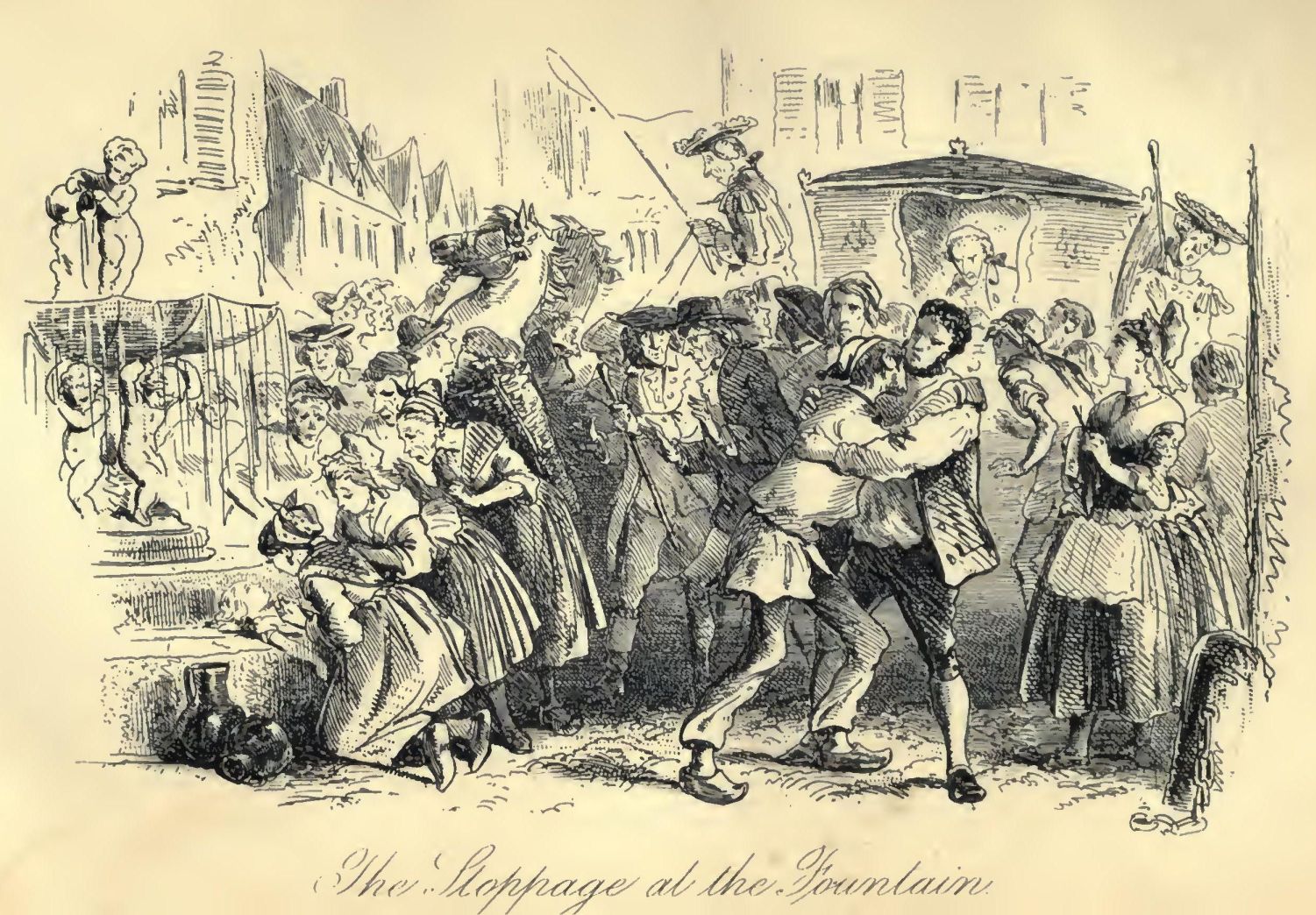
Licking Wine From the Street

My wife once told me a story from A Tale of Two Cities. It took place in a small village outside of Paris in the late 18th century. The French Revolution had not yet begun, and the townspeople were living under oppressive poverty.

One day a large cask of wine was being unloaded from a cart when it tumbled, fell, and “shattered like a walnut shell.” Wine poured out into the street, making pools and rivulets in the cobblestones. The townspeople stopped what they were doing to attend to the spilled wine.

Some men kneeled down, made scoops of their two hands joined, and sipped, or tried to help women, who bent over their shoulders, to sip, before the wine had all run out between their fingers. Others, men and women, dipped in the puddles with little mugs of mutilated earthenware, or even with handkerchiefs from women’s heads, which were squeezed dry into infants’ mouths…. others devoted themselves to the sodden and lee-dyed pieces of the cask, licking, and even champing the moister wine-rotted fragments with eager relish.

Did the townspeople lose their humanity? That’s one way to read the story. Like a pack of hyenas on an antelope they scavenge, staining their hands and faces blood red. Without dignity or composure, they lick to the lees.

Yet a broken cask of wine is not like a fallen antelope. The meat of the antelope keeps the hyenas alive, but the spilled wine keeps the townspeople human. They scoop up a dribble in a broken pot to taste the product of human ingenuity. They bury their faces in the wine-dark street to celebrate a memory of celebration.

And this celebration is not private. Like all festivals, it is public. Even the infants get a handkerchief of wine.

There was a special companionship in it, an observable inclination on the part of every one to join some other one, which led, especially among the luckier or lighter-hearted, to frolicsome embraces, drinking of healths, shaking of hands, and even joining of hands and dancing, a dozen together.

We all seem to be alarmed of late. Conservatives and liberals are both wringing their hands, convinced of a looming dystopia. In light of these concerns, perhaps Dickens’s story could be read as a kind of doomsday preparation. In what ways can we exercise and celebrate our freedoms by being connoisseurs of the products of civilization?

When was the last time you tasted something so urgently as those townspeople tasted that spilt wine? When did you last savor a taste of coffee or a conversation or a song as though it were the official representative of humanity – a scrap, a souvenir of goodness? We don’t lack for treats, generally. But we do often lack for attention.

Furthermore, when did you last make something worth savoring? Have you made a meal, built a campfire, or told a story that is worthy of rapt attention? It needn’t be perfect. But, like wine mixed with the mud on the street, it should contain some notion of the human, which itself contains some notion of the divine.

Aristotle’s Guide to Weight Loss

Last week I posted some thoughts regarding virtue ethics.  The previous week I wrote disparagingly about Clean Eating. Since then, a lot of people have asked me about the connection between diet and virtue.


OK, Tom Hanks is right. No one has asked me that. But still, it’s a question I’d like to engage. Because it isn’t as though Americans are particularly healthy. Our habits are so far from what they ought to be that the FDA has approved a device that will suck the bad decisions right out of your stomach.

So if what we’re doing isn’t working, and if Clean Eating isn’t the solution, what should we do? I’m so glad you asked.

Diets are like tightropes, suspended a few inches off of the ground. People have strong opinions about which tightrope is best. Maybe they’re a believer in Paleo, raw food, or intermittent fasting. But whichever tightrope they choose, that’s their focus. They hope to stay on the tightrope indefinitely (or at least into the ill-defined future). Through the pure exertion of willpower, they intend to balance perfectly until balancing becomes as easy as walking.

Of course, things seldom work out this way. Life becomes demanding, busy, or unpredictable, and so they fall off of the tightrope. Maybe they try to hop back on, but before long, they are on the ground again. Eventually they find that they’ve abandoned the tightrope all together. They are walking again on the same ground they’ve tried to leave behind so many times before. Perhaps they’ve even become interested in a new tightrope. What’s this Keto diet all about?

UCLA researcher Tracy Mann conducted a study that looked into the problems with dieting.

We found that the majority of people regained all the weight, plus more. Sustained weight loss was found only in a small minority of participants, while complete weight regain was found in the majority. Diets do not lead to sustained weight loss or health benefits for the majority of people.

Although diets tend to be effective in the short term, dieters tend to fall off the tightrope in the long term. And, over time, all of those falls begin to take a toll.

We concluded most of [the study participants] would have been better off not going on the diet at all. Their weight would be pretty much the same, and their bodies would not suffer the wear and tear from losing weight and gaining it all back.

Ms. Mann isn’t the only one criticizing dieting. Sandra Aamodt’s popular TED Talk explains why diets make us fat. And just yesterday, NPR reported that yo-yo dieting may be bad for our hearts.

So, what does Virtue Ethics have to say about all of this? What, exactly, is the Aristotelian plan for weight loss? As I described last week, Virtue Ethics is chiefly concerned with what kind of people we are. In other words, it is less interested in the tightrope than it is in the ground. And so the key question is: when we fall of our diets, where do we land? What are our underlying habits? And what does it take to change them?

Our habits are the things we do without trying. Our habits don’t take any willpower. For instance, imagine that you wake up one Saturday morning to find that your spouse has bought a box of doughnuts. You’re probably going to eat some, but not all, of those doughnuts. As much as you might like doughnuts, you probably don’t evenwant to eat all of them. When you manage not to eat an entire box of doughnuts, you aren’t exercising willpower. You aren’t walking on a tightrope. You are walking on the ground.

I’m more interested in changing my habits than I am in balancing perfectly upon some artificial diet. When I think about my life 10 or 20 years from now, I want health to be second nature. To achieve that, I think I need to pay more attention to my habits than the latest nutritional fad.

For the past couple of years I’ve been working on this very thing. I’ve chosen one habit per year that I want to change, and made that my focus. I try to think about what I really want to do, not just for this year, but for the rest of my life. For the first year, for instance, I focused on overeating. I noticed that I had a tendency to mindlessly finish the food on my plate, whether I was hungry for it or not. The resulting over-full feeling was something I was happy to be rid of.

That first year seemed to be moving awfully slowly. I didn’t feel like I was doing enough. The plan didn’t seem sufficiently difficult. Yet, the habit has stuck. It’s not something I have to think about any more because it has become second nature. For instance, if I eat a lot of chips and salsa before a meal, I take it pretty slow on the meal. I had to consciously pay attention to it for the first few months. But somewhere between then and now it has become second nature.

This has been a somewhat strange post to write. Talking about dieting seems at once too personal and not serious enough. Yet, it’s clearly something that a lot of people spend a lot of time thinking about and even anguishing over. Virtue Ethics may be the stuff of serious books and learned lectures. Yet, I think it has application for this kind of very practical subject.

Is Spontaneity a Virtue?

Imagine a young woman being pursued by two suitors. The first is staid and predictable. He’s consistent, punctual, and perhaps a bit boring. The second is spontaneous. He tends towards the unexpected and adventurous.

Our young woman considers a life with each of these men. She imagines that the first is a safe choice. He won’t quit his job on a whim to become a skydiving instructor. [Note: this example intends no offense towards the skydiving instructors upon whom our nation depends.] However, the safety he offers isn’t likely to be exciting. The second guy, on the other hand, may be more whimsical than trustworthy. He might be more fun, but will he bail on his vows in a fit of spontaneity?

All else being equal, which guy should she pick? Or, to put it more broadly: is spontaneity a virtue? Is it a characteristic we should value in others and attempt to cultivate in ourselves? Virtue ethics offers some clarity to this question.

The school of thought known as virtue ethics was developed in ancient Greece and has been a subject of renewed interest in recent decades. It recognizes four cardinal virtues which, taken together, represent an ideal of human development. The four virtues – Prudence, Justice, Courage, and Temperance – don’t appear to contain anything having to do with spontaneity. If anything, the virtue of temperance would seem to suggest against it. Temperance is about resisting temptation, after all, and the spontaneous person seems to be giving in to temptation.

But take a closer look at courage. Courage is the ability to overcome fear or difficulty in service of the good. Historically, courage is most closely associated with the warrior who must endure hardship and danger, long marches and fierce opponents, to complete a mission. Courage has two faces. It entails both endurance and attack.

The brave man not only knows how to bear inevitable evil with equanimity; he will also not hesitate to ‘pounce upon’ evil and to bar its way, if this can reasonably be done. – Josef Pieper

Endurance, or fortitude, is the ability to withstand difficulty. The mountaineer trudging up the peak and the shift worker dragging himself out of bed in the morning are both exhibiting courage. They are actively sticking with a difficult thing because it is what needs to be done. Endurance is the persevering, unchanging, even stoic face of courage.

The willingness and ability to attack is an aspect of courage that looks very different from endurance. Unlike endurance, attack presents itself suddenly, in a decisive moment. A courageous man who sees a woman being abused in a parking lot will intervene.

And, pertinent to our question, virtue ethics calls on him to act this way without deliberation. Courage should be second nature. This differs from the modern tendency of thinking that ethical questions pertain to what we do. Virtue ethics is more interested in what kind of people we are.  Through long habituation, courage becomes automatic. As Aristotle said, “we become just by doing just acts, temperate by doing temperate acts, brave by doing brave acts.”

Paradoxically, courage may cause a person to seem both steady and spontaneous. Life often calls for faithful repetition. It is an act of fortitude to clean the same dishes every day, to exercise regularly, and to consistently report to work on time. However, there are those times when one must become critical of an established routine; when the path of safety and familiarity should be questioned and rejected. There is a time to endure and a time to attack.

Our imaginary young woman would do well to consider which of her suitors is more courageous. Perhaps the first man is predictable because he is timid. Maybe he is simply too afraid to do anything outside of his routine. If so, then life with this man is likely to be not only boring, but shameful. The situation is different, however, if his consistency is a sign of courage. It may be that he has developed the habits of fortitude. The evidence will be in his actions.

As for the second man, is his spontaneity the result of courage or evidence of its absence? Is his apparent whimsy actually a demonstration that he cares more about goodness than convention? Maybe the pursuit of the good life will often appear idiosyncratic.

Then again, what looks like free spiritedness may actually be cowardice. It may be an inability to suffer under discomfort. And so our imaginary young woman will have to ask herself which of these men is more courageous. Which is more likely to meet the challenges of courage, whether of endurance or attack?
 

Clean Eating

Seven years ago, 3 teenage boys took a joyride in a small aluminum boat they’d stolen from an uncle. The boys lived on the Tokelau Islands, a small remote pacific atoll governed by New Zealand. The boys were familiar with the ocean and its dangers, but that familiarity couldn’t restrain their youthful desire for adventure.

In the middle of the night, they pushed off into the open sea, hoping to reach a neighboring island within a few days. Instead, they drifted like a speck in the Pacific Ocean. Before they were rescued, they spent more than fifty days bobbing in salt water with barely any food or water.

One day, malnourished and sick from the sun, the boys watched as a gray gull landed on their boat. Quickly grabbing the bird, they twisted its neck, and plucked its feathers. They pulled off its skin with their teeth before devouring the meat, organs, and the contents of the bird’s stomach. They then crushed and ate the bones, and with growling stomachs wished for more.

****

The eleventh chapter of Leviticus names twenty different birds that should be regarded as unclean, inedible. “The gull” is among them. Distinctions between clean and unclean are applied to the animals of the land and the sea, and of insects. Some can be eaten; others must be avoided.

You must distinguish between the unclean and the clean, between living creatures that may be eaten and those that may not be eaten.

In the Gospels, Jesus dismisses these dietary restrictions. It’s not what goes into your mouth that defiles you, he says, but what comes out of your mouth. Whatever is put in the mouth will eventually be expelled. “But the things that come out of a person’s mouth come from the heart, and these defile them.”

The apostle Peter, having grown up with the dietary restrictions of Leviticus, internalized their logic of disgust. Lizards and catfish represented contamination. Camels and rabbits, through long habituation, were repellent to him. And so it took a vision from heaven to expand his diet.

He saw heaven opened and something like a large sheet being let down to earth by its four corners. It contained all kinds of four-footed animals, as well as reptiles and birds. Then a voice told him, “Get up, Peter. Kill and eat.”

“Surely not, Lord!” Peter replied. “I have never eaten anything impure or unclean.”

The voice spoke to him a second time, “Do not call anything impure that God has made clean.”

****

There is a way of relating to food that is only nominally about health. Its chief concern is the aesthetics of purity. It fetishizes the natural, a concept which its adherents can identify intuitively, but cannot quite define. Kale is natural, as are flax seeds. Wheat and corn are not.  

Gwyneth Paltrow, who has published multiple cookbooks, is a priestess of the religion of Clean Eating. She offers spiritual guidance to her followers, covered in a diaphanous layer of pseudoscience.

The bottom line is, our bodies have a hard time with anything processed. That doesn’t only mean kool-aid and goldfish. White flour, white rice and soy milk are all heavily processed as well.

Or again,

We’re human beings and the sun is the sun—how can it be bad for you? I don’t think anything that’s natural can be bad for you.

Clean Eating is driven by a religious impulse to avoid contamination. But, unlike the Levitical proscriptions, the source of defilement here is modernity. It isn’t the pig that’s to be avoided, but the pig’s antibiotics and growth hormones. It’s his sunless stall and the industrial methods of his processing facility that cause impurity.

Clean Eating’s adherents must strive to avoid that which is artificial or manufactured. Through rituals like juice fasts and cleanses, they can atone for the toxins they’ve ingested. In so doing they strive to recover a kind of Edenic innocence. As a recent article explained, “It seems that the further we go with fancy and intricate treatments, the more we’re engaging in a ritual effort to make ourselves pure again.”

But the path of Clean Eating is asymptotal. It desires a state of purity that is always just out of reach. More antioxidants are always needed, more potent probiotics, or a more exotic source of hydration.

Those boys from Tokelau, starving almost to death, confronted an unsavory truth. Our day to day existence depends on sacrifice. The only way to stave off our own death is by killing and ingesting plants and animals. It’s a process that weds us to the world and frustrates our attempts at a diet-based transcendence.

Flash Review: Into the Wild

I first read Into the Wild as a teenager. I was working at a Christian bookstore at the time, selling copies of Left Behind and The Prayer of Jabez in a shopping center off the highway. On breaks I would walk across parking lots and past chain restaurants to the Barnes & Noble to read John Krakauer’s account of Christopher McCandless.

McCandless was a young man with a deep longing for the wilderness and an acute awareness that civilized society could not answer that longing. After graduating college, he gave his money away to charity, cut off ties with his family, changed his name, and walked into the mountains of Alaska.

There was something thrilling about living vicariously through McCandless. My view may have been dominated by parking lots and overpasses, but he was immersed in, “nature in its most staggering grandeur.” What’s more, McCandless took his longing seriously. He refused to be content in anything less than a radical existence.

McCandless was a kind of secular saint of longing. He held nothing back, but gave himself over entirely to the object of his desire. He was also a martyr. His body was found by a hunter just a few months after he entered the Alaskan wilderness.

His story, sad as it was, articulated something that I hadn’t found in the shelves of the Christian bookstore. It spoke of human longing, and of the ways in which those longings make us wild.

Flash Review: The Supper of the Lamb

At times, reading Robert Capon’s The Supper of the Lamb feels like being shown around a quaint cooking shop by its aged proprietor. He strolls with you through the aisles, offering delightful, unsolicited advice on culinary implements:

If you never sharpen your own knives, you will no doubt prefer stainless ones; but if you are the constant whetter of edges you ought to be, only carbon steel blades will keep you happy.

Your guide betrays a surprising familiarity with onions, pointing out that, once they’ve been cut in half, they can’t be fit together again.

The faces which began as two plane surfaces drawn by a straight blade are now mutually convex, and rock against each other.

Such idiosyncratic nuggets of wisdom are worth the price of the book. However, the real value comes as you realize that your host is brilliant as well as funny. His theological and philosophical reflections offer keen insight into the nature of reality.

Things must be met for themselves. To take them only for their meaning is to convert them into gods – to make them too important, and therefore to make them unimportant altogether. Idolatry has two faults. It is not only a slur on the true God; it is also an insult to true things.

What Happened to Lewis and Chesterton?

In his autobiography, G.K. Chesterton, the great 19th century British author, describes a formative early experience. “The very first thing I can ever remember seeing with my own eyes was a young man walking across a bridge. He had a curly moustache and an attitude of confidence verging on swagger.”

The man, we’re told, was carrying a key across a bridge that led to a tall tower. The tower contained a woman, about which he says, “I cannot remember in the least what she looked like; but I will do battle with anyone who denies her superlative good looks.”

This scene was of a toy theater, a kind of diorama that his father had made for him and placed in his nursery. Such a toy might seem unimpressive to an adult, but to the young Chesterton there was nothing more sublime, “…that one scene glows in my memory like a glimpse of some incredible paradise; and, for all I know, I shall still remember it when all other memory is gone out of my mind.”

This early aesthetic experience was a critical moment in Chesterton’s formation. In it, he felt “the fragmentary suggestions of a philosophy I have since found to be the truth.” That philosophy, as he describes in Orthodoxy, was the Christian faith.

Chesterton wasn’t the only British author to have such an experience. In Surprised by Joy, C.S. Lewis also tells of an aesthetic childhood experience prompted by a diorama. “Once in those very early days my brother brought into the nursery the lid of a biscuit tin which he had covered with moss and garnished with twigs and flowers so as to make it a toy garden or a toy forest. That was the first beauty I ever knew….As long as I live my imagination of Paradise will retain something of my brother’s toy garden.”

These men both glimpsed Paradise in miniature. Chivalry and nature, scaled down, called out to them and they never recovered.

As I reflect on these two remarkably similar experiences, I am curious about the significance of childhood wonder. Are we formed in some way through our encounters with longing? Leon Wiesltierjan seems to believe that we are. In his essay, Among the Disrupted, he claims that humanism has an underlying pedagogy. It makes claims about how we learn. Namely, he says that personal cultivation happens “…by means of textual study and aesthetic experience.”

Most of us are anxious for our kids to become literate. We want them to develop a love of reading and to engage with important works of literature. But, if Wiesltierjan is right, people who love reading are still only half formed. Kids need beauty as much as they need truth. And, as Lewis and Chesterton’s stories show, they don’t have to travel far to find it. It could be waiting in a toy theater or in the lid of a biscuit tin.

The Problem With Margaritaville

Currently under construction in Daytona Beach, Florida is a development called Latitude Margaritaville. When it’s finished next year, it will have about 7,000 homes available to buyers 55 or older. This isn’t a new concept; gated communities for seniors have been around for a while. What sets Margaritaville apart is that it is (to quote the press release) “an immersive brand experience.” It’s being designed and built so that fans of Jimmy Buffett (who, I regret to inform you, call themselves “parrotheads”) can live out their days as Buffett intended.

If you’re like me, news of Margaritaville results in conflicted feelings. On the one hand, you wish the future residents of this place no ill will. You don’t believe that they will be doing anything wrong by living there. You hope they’ll enjoy the sun, the shmaltz, and the presumably endless looping of Buffett’s ode to lost salt shakers. Yet, you sense that there’s something creepily dystopian about the whole enterprise.

Buffett’s song, which was recorded in the late 70’s, evoked a certain lifestyle. Indeed, it offered a vision of the good life. It painted the picture of a man who had abandoned the respectability of the American dream to become a beach bum, subsisting on sponge cake and boiled shrimp. He’s an anti-hero who by his authenticity has transcended the tourists whom he views from his front porch.

Undoubtedly, this song has provided a pleasant escape for many people. It has been the occasion for insurance adjusters in Phoenix and dental assistants in Houston to imagine themselves with sand in their toes and drinks in their hands, answering to no one but themselves. And, after a few decades of punching a clock and diverting funds to their 401Ks, they are finally ready to make their dreams a reality.

So it feels a bit mean to state the obvious. The future residents of Margaritaville are not countercultural beach bums who’ve checked out of the rat race. Instead, they are pliant consumers, signing on the dotted line in exactly the manner that Minto Communities LLC (the development company behind Margaritaville) predicted they would.

Of course, such a phenomenon is not unique to parrotheads (it is genuinely painful for me to type that word). Plenty of us express a toothless rebellion through consumption. Businesses like Hard Rock Cafe and Hot Topic have long offered counterculture as a commodity, The Ramones have sold more t-shirts than albums, and the author of this post, who will never attempt an ascent of Half Dome, is currently wearing a The North Face shirt.

The existence of Margaritaville raises a few interesting questions. For instance, what is the meaning of place in such a development? What are the pros and cons of “an immersive branding experience” as compared to a traditional community? But I’ll leave those questions to you and attempt an answer at another. What does Margaritaville tell us about the human experience?

Life can be difficult, even for people who have it relatively easy. As kids, we imagined that adulthood equaled freedom. But upon arrival we learn that there are consequences to eating too much, drinking too much, spending too much, and not exercising enough. We worry about our kids, our jobs, and that knocking sound coming from the car’s engine.

What if our interests and hobbies are, in part, ways of coping with the weight of responsibility? What if record collections, sports fanaticism, and cosplay conferences are valuable chiefly for the existential comfort they provide? Understood in this way, the differences between (for instance) the urban hipster and the resident of Margaritaville are minor. We may not identify with either one of them, but we can sympathize with them both.

The Domestic Trap

I have recently felt sympathy for an adulterous woman. Such feelings are ill advised, I know. Proverbs says that the adulterous woman is bitter as gall and that her house is a highway to the grave. It says to stay away from her. Yet I can’t help being drawn in as I read Melissa Matthewson’s recent essay, On Coupling.

My sympathy is partially due to the quality of Matthewson’s writing. She weaves autobiography, confession, and zoological reflection together in a way that feels at once sober and urgent. Yet her intentions are plain. “I don’t want to follow the rules of marriage, of monogamy.”

She proposes open marriage to her husband, who is uninterested. “He muses over my idea that maybe we aren’t meant for one person. He doesn’t agree. He wants only me.”

Matthewson is careful not to present her husband as the problem. She describes him as loyal, steadfast, hardworking, and accommodating. “I think of my husband’s identity, unwavering in his love, his steady focus on work, on pleasing everyone but himself. I think, He’s selfless. And I’m not.

Her issue, rather, is that domesticity has become a trap. Married life is a pallid imitation of what she’d hoped it would be. She mourns the loss of passion and “how domesticity might drown your identity.” She expresses apathy towards the mundane realities of housekeeping. “I don’t like doing dishes,” she says. “I’m not interested in how a vacuum works.”

It would be easy to dismiss Matthewson’s complaints as selfish, to condemn her with a ready-made script. For instance, to point out that she made a commitment to her husband, and that her kids need their mom. Or to tell her to stop complaining, act like an adult, and do what’s right.

In fact, I hope she knows someone that she trusts, who is wise, who can say something like that to her. But I doubt it would do much good for me to rail against this stranger. Instead, I’d like to point out something curious.

The woman in this essay is, to use the currently ubiquitous phrase, privileged. She has travelled internationally, earned multiple advanced degrees, and found myriad outlets for her creative energies. Her website says that she is a farmer, a writer, and a dance instructor who runs an organic market. In short, she is not living the life that Betty Friedan warned us about.

Despite this, she is unfulfilled. She suspects that there is something more to being human than her domestic life offers. “Everywhere I go….I judge the nature of married couples, believe they aren’t subversive enough, their lives too ordinary.” She reminds me of the character from Tolstoy’s short story, Family Happiness.

I wanted excitement and the chance to sacrifice myself for my love. I felt in myself a superabundance of energy which found no outlet in our quiet life.

Privilege seems largely to be a term of dismissal. We are assured that anyone to whom that pejorative has been applied can be safely ignored. Yet, the privileged are able to consider the ways in which life, even at its best, is unsatisfactory. Those who lack basics such as food and safety are likely to focus their efforts on satisfying those necessities. Such efforts leave little time for nursing a vague feeling of dissatisfaction.

The French philosopher Rene’ Girard stated the phenomenon in this way, “once their natural needs are satisfied, humans desire intensely, but they don’t know exactly what they desire, for no instinct guides them.” Indeed, Matthewson desires intensely. She articulates that desire well, giving voice to a profound human need. But her solution to that need is tragic insofar as it is damaging to herself and her family and hopeless to satisfy her.

(Here I am making assertions rather than arguments. I am claiming that infidelity damages the person who commits it as well as the person against whom it is committed. Further, I am claiming that it isn’t a sufficient response to longing. I believe such assertions are defensible, though it is not now my task to defend them.)

Perhaps caution would seem like the proper Christian response to longing. Don’t take it too seriously, and maybe it will go away. Such a path may seem prudent, but Augustine took a different approach. In a homily on the first epistle of John, the great African theologian claimed that, “the whole life of a good Christian,” consists of desire. God alone can satisfy our longings, and so he reasoned that those longings ought to be taken seriously.

I am confident that Matthewson’s experiment will fail. Humans are not so simple as to have their longings satisfied by promiscuity. Yet, to say so is no indictment of longing. Rather, it is a call to reject insufficient answers to our longing. “Let us desire therefore, my brethren, for we shall be filled.”